📄 Digital book in PDF · read it on your phone or print it
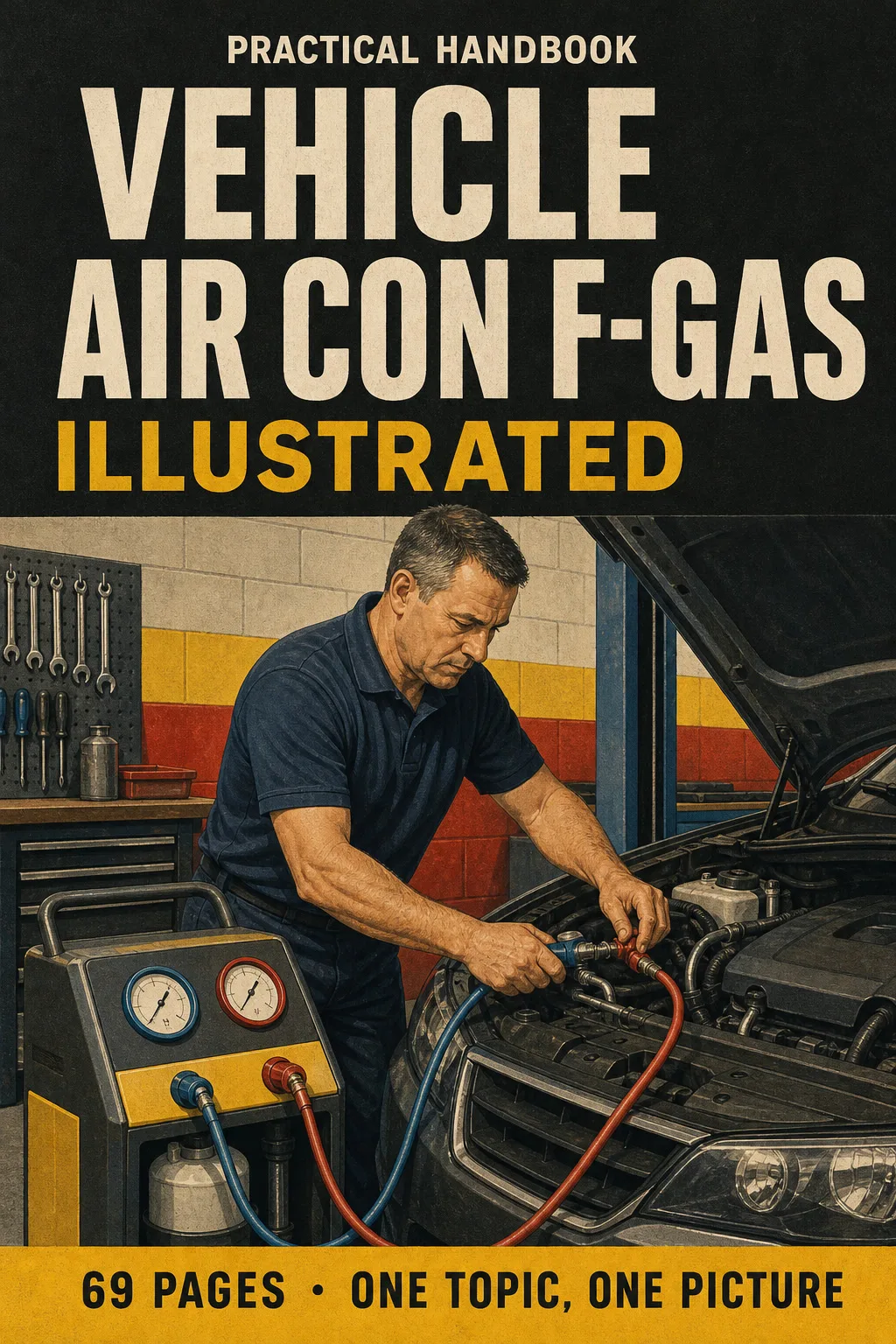
For technicians who already do air con and need the qualification. R134a and R1234yf, PAG and POE, gauge readings, hybrids and EVs, and the GB F-gas rules: the drawing first, then what to remember. 69 illustrated pages.
🔒 Secure checkout · PDF by email · 30-day guarantee
Every page has one large drawing and a box with the readings, steps and rules you need to know:


Swipe to see more →
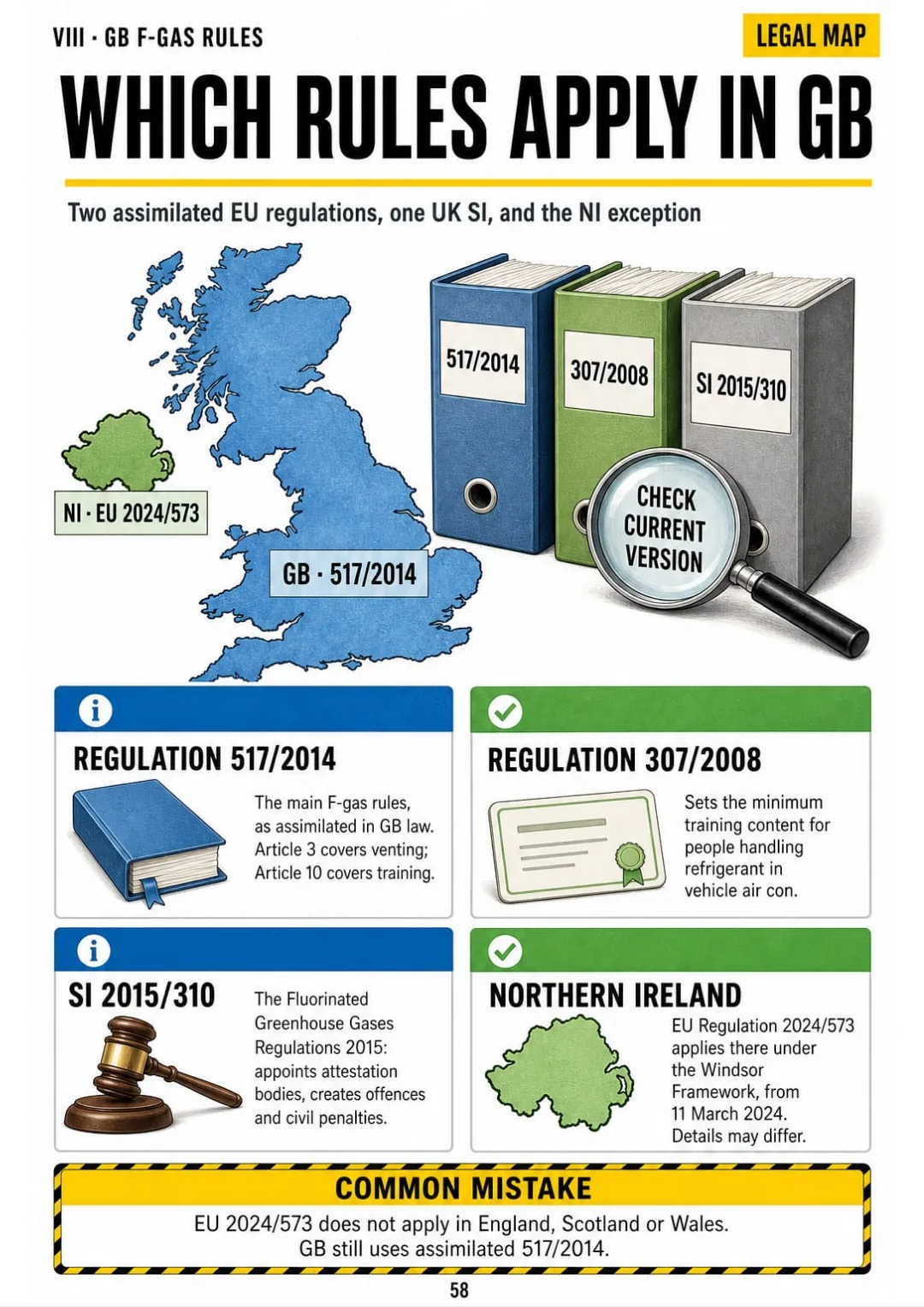
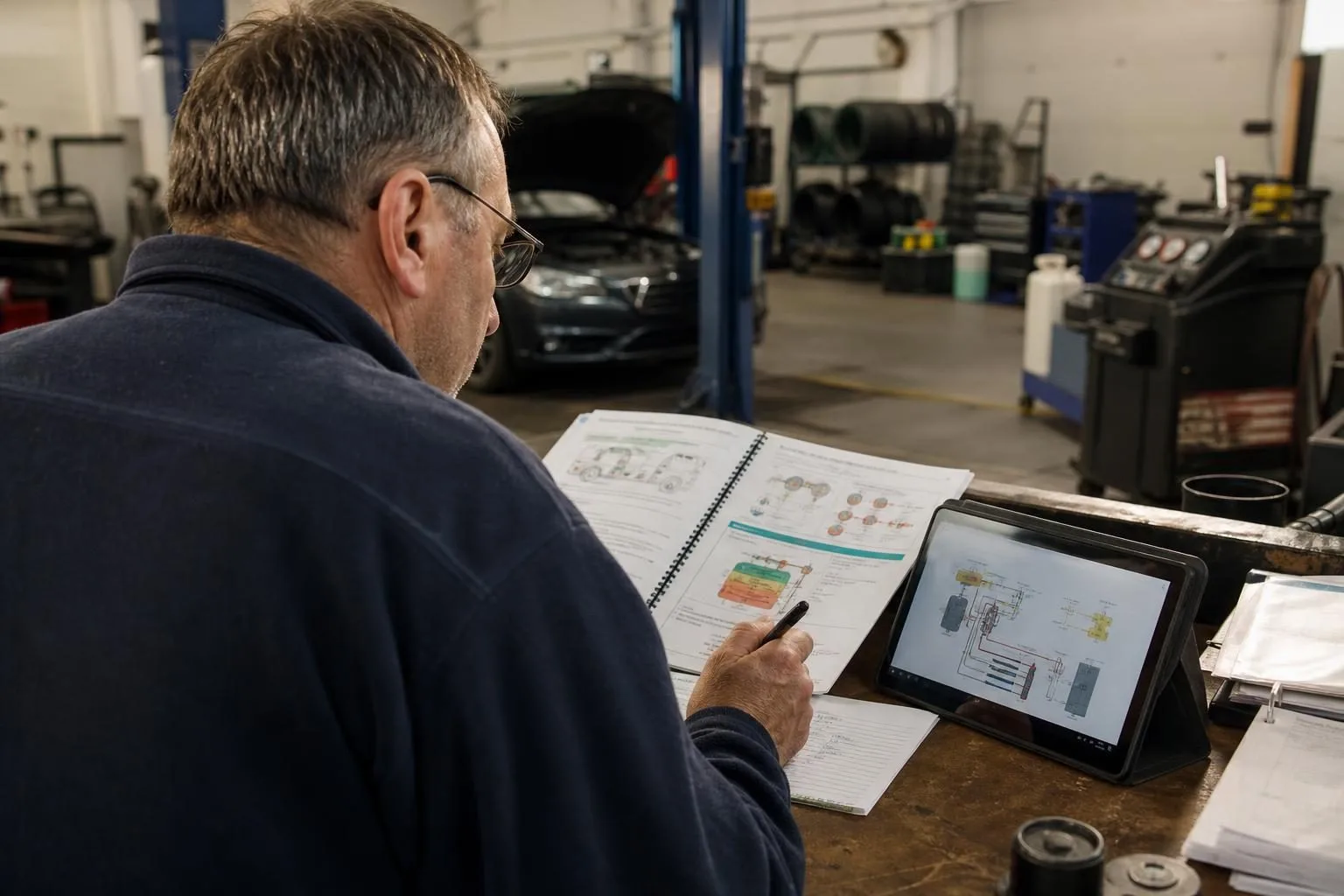
These are real pages from the book. The table of contents is the full one: 9 parts and 65 topics.
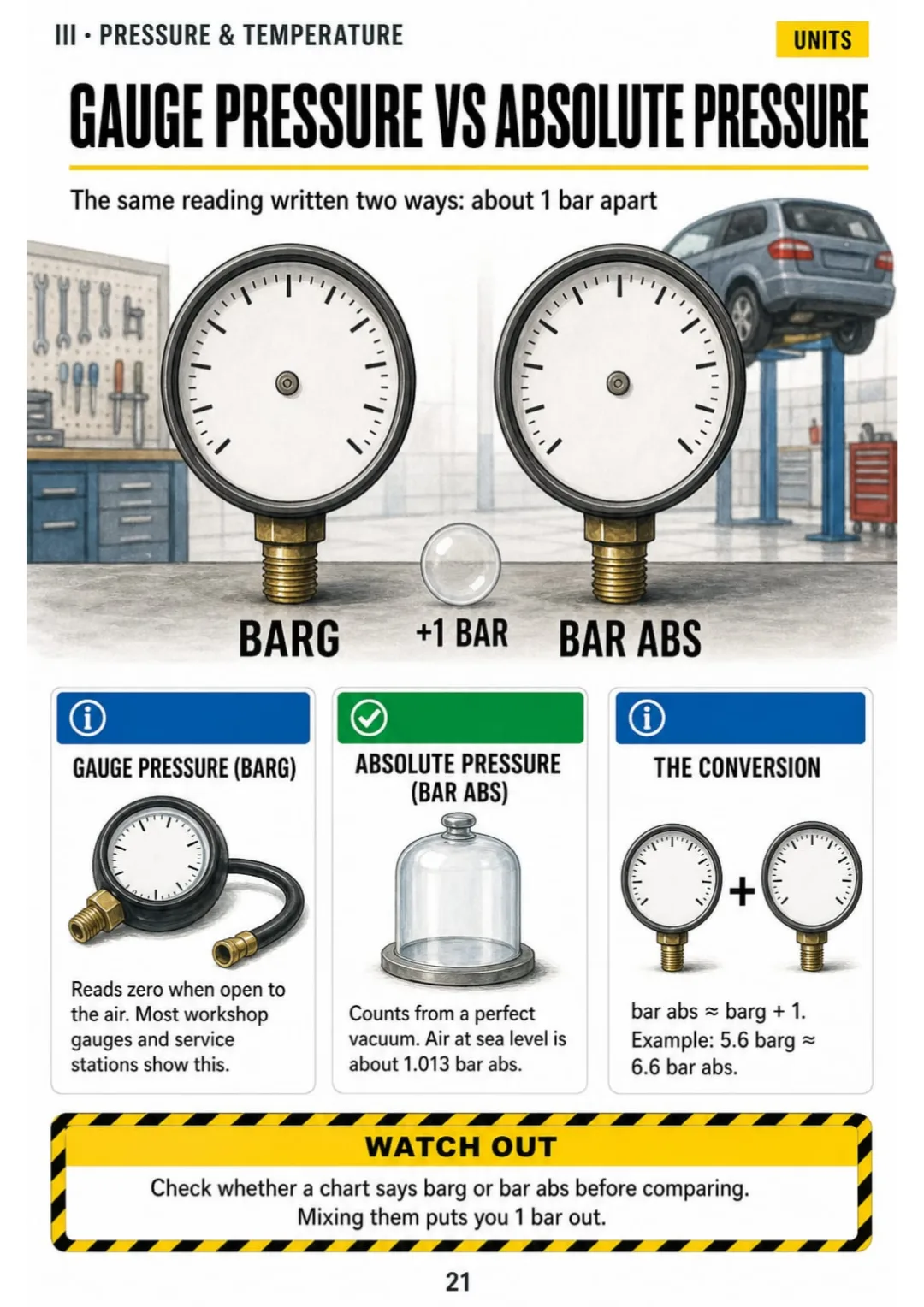
You're at the car with the gauges on. The blue needle reads 2 bar and you open a P-T chart to check it. The chart is in bar absolute, your gauge reads bar gauge. Which number do you compare?
The manual gives it three paragraphs on atmospheric pressure, reference points and units. You read it, it made sense, and the next morning it had gone. Pressure was explained in words and never shown.

In this book it's one page: a gauge reading zero at atmosphere, next to an absolute scale that starts at a full vacuum. And one box: bar abs ≈ barg + 1. Check the chart heading before you compare any reading.
Static pressure, superheat, subcooling, the R134a and R1234yf curves and the way ambient temperature changes every reading work the same way: each one on its own page.
You look at the gauge, then at the chart heading, and you know which number you're reading. No going back to the manual.

The circuit, refrigerants and oils, pressure and temperature, reading the gauges, finding the leak, the AC service station, safety with hybrids and EVs, the GB F-gas rules and revision before the assessment: 69 pages, all illustrated
Think of it this way:
A car comes in with warm vents. You connect the gauges and both needles sit low. The customer is standing there asking whether a top-up will do.
You open the page Undercharged: both sides low and there are the blue and red gauges, drawn as they read, with what you feel at the vents, the likely cause, and the next step: find the leak before you charge.

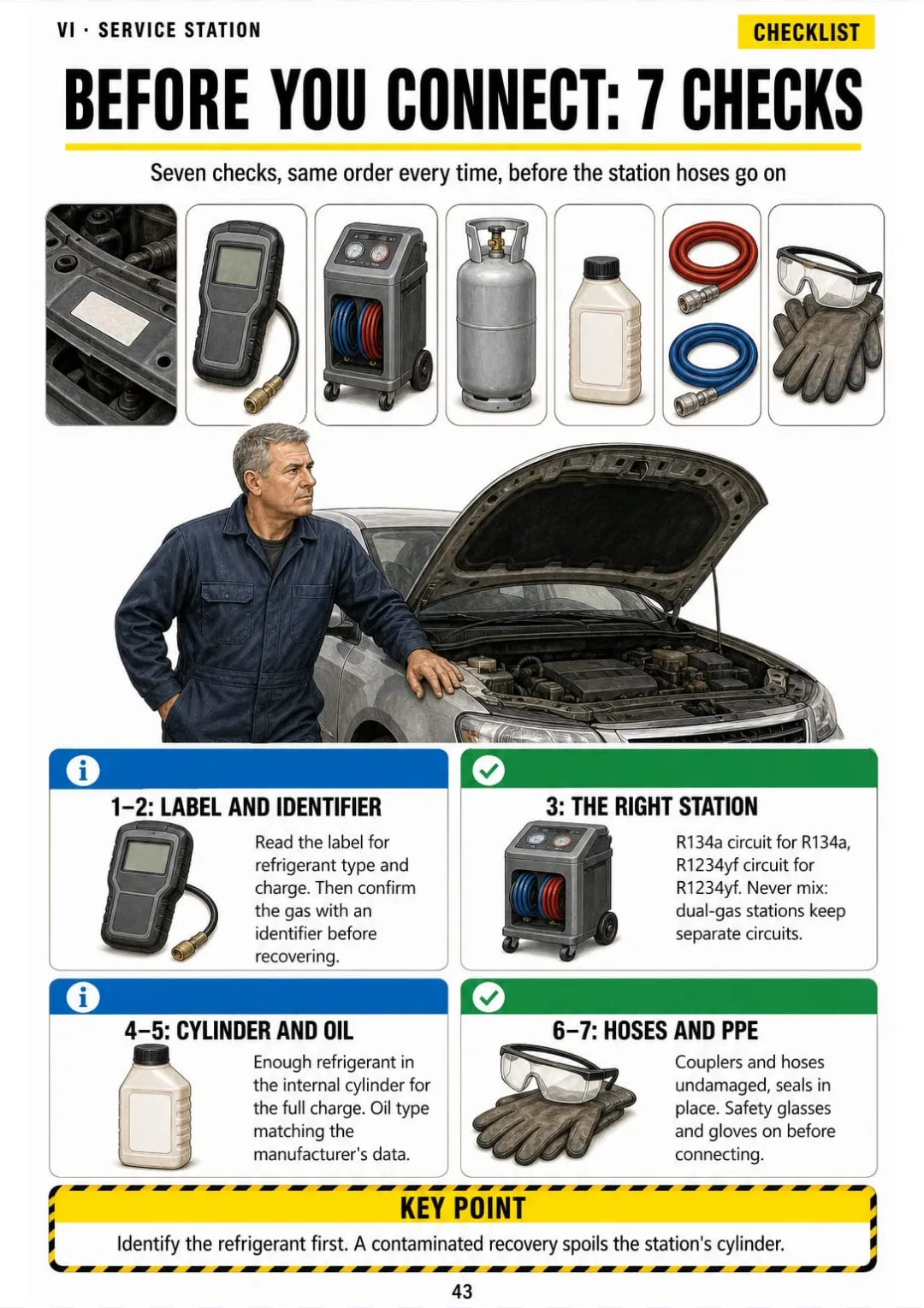
The 7 checks before you connect, recovery, vacuum and the hold test, charging by weight and R1234yf's mild flammability work the same way: each one on its own page.
Vehicle Air Con F-Gas Illustrated has 9 parts and 65 topics, all drawn, with a revision part at the end: every gauge fault on one page, the service sequence in one line and the key numbers.
What you see drawn, you don't have to memorize.
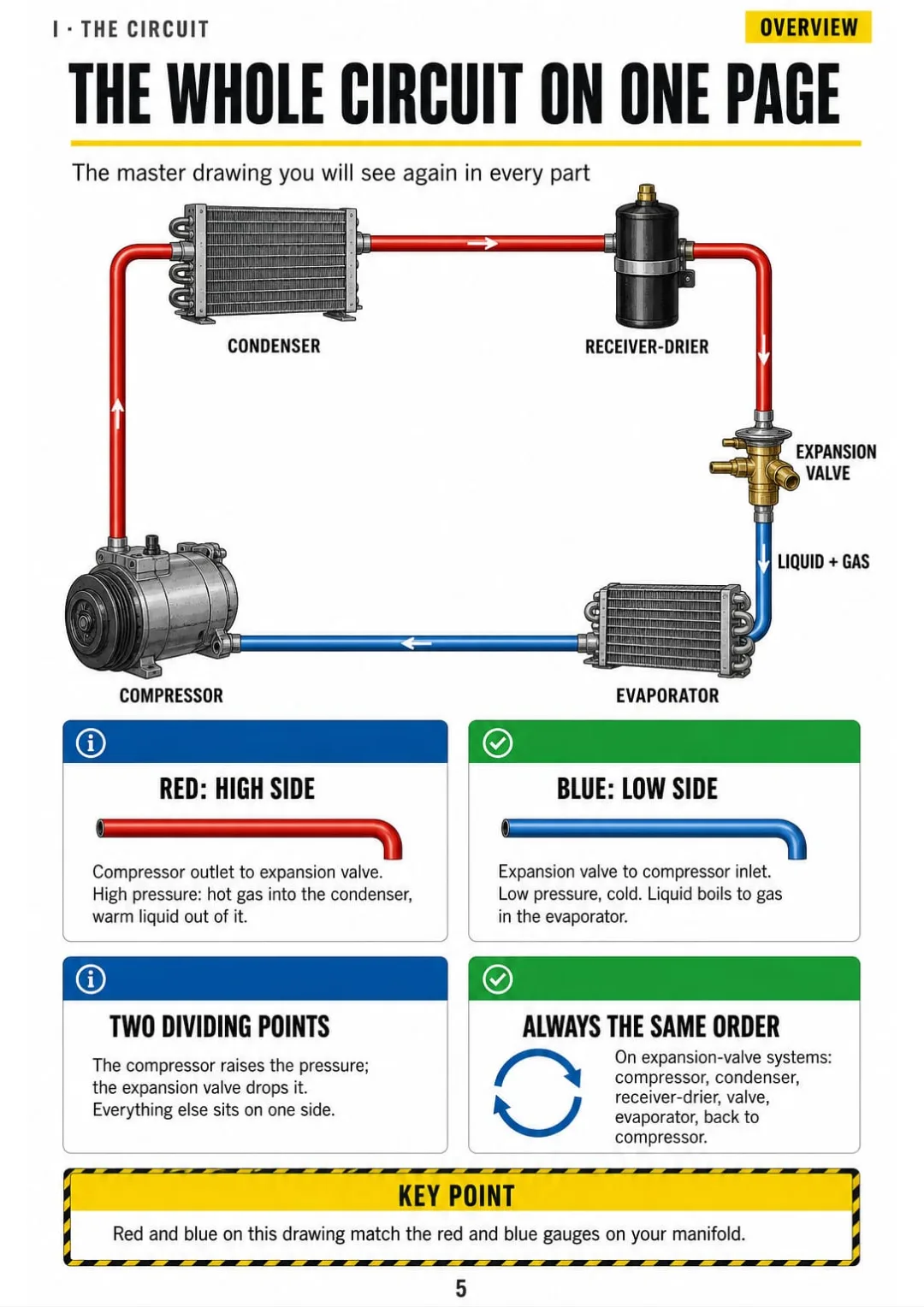
See the whole system before any detail: the circuit in one drawing, the four changes of state, compressor, condenser and fan, expansion valve or orifice tube, receiver-drier or accumulator, evaporator, sensors, switches and service ports.
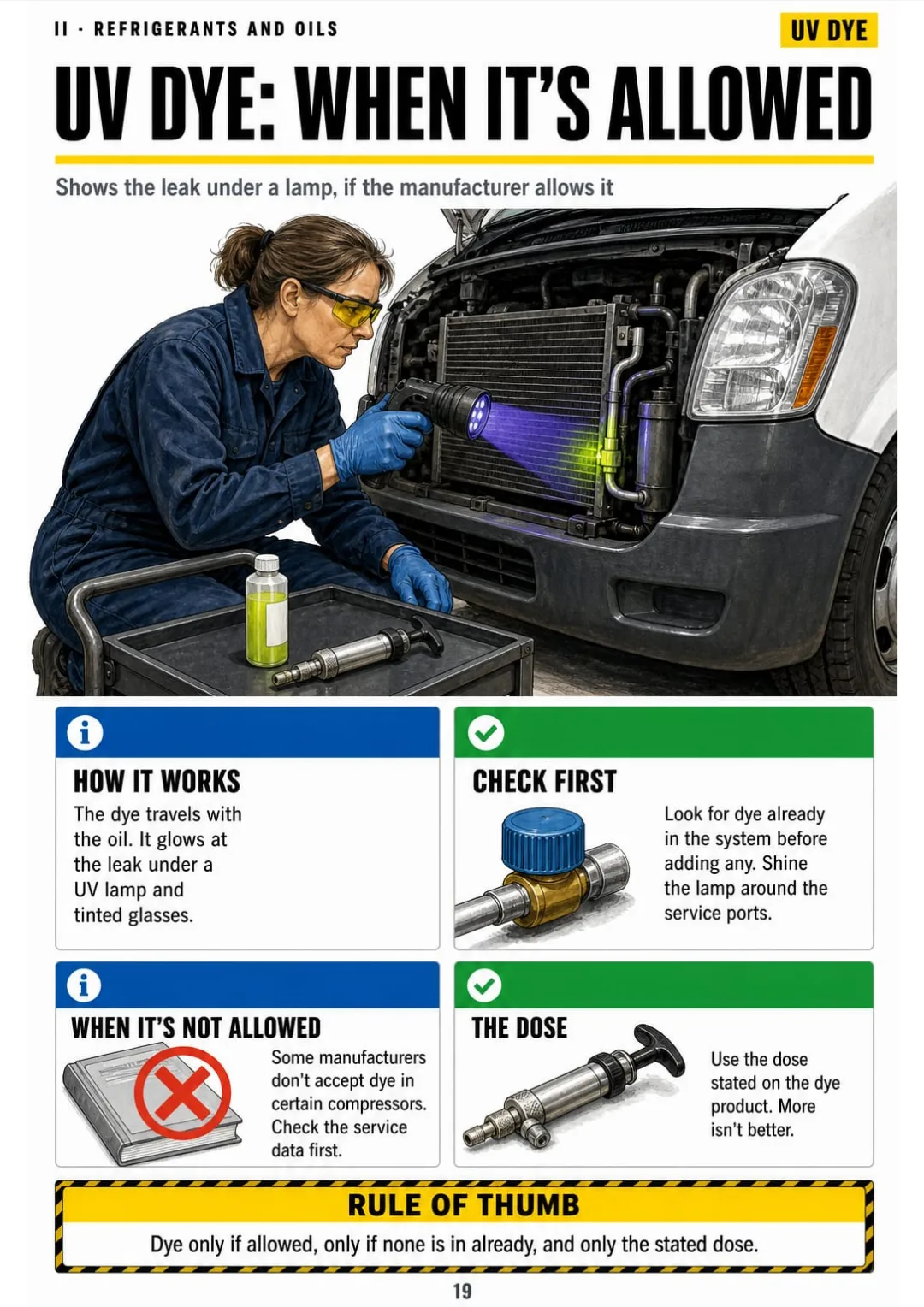
R134a and R1234yf, reading the under-bonnet label, identifying before you connect, PAG and POE oils, UV dye and the GWP to CO2 equivalent sum.
Gauge and absolute pressure, the pressure-temperature relationship, static pressure, both curves side by side, superheat, subcooling and the effect of ambient temperature.
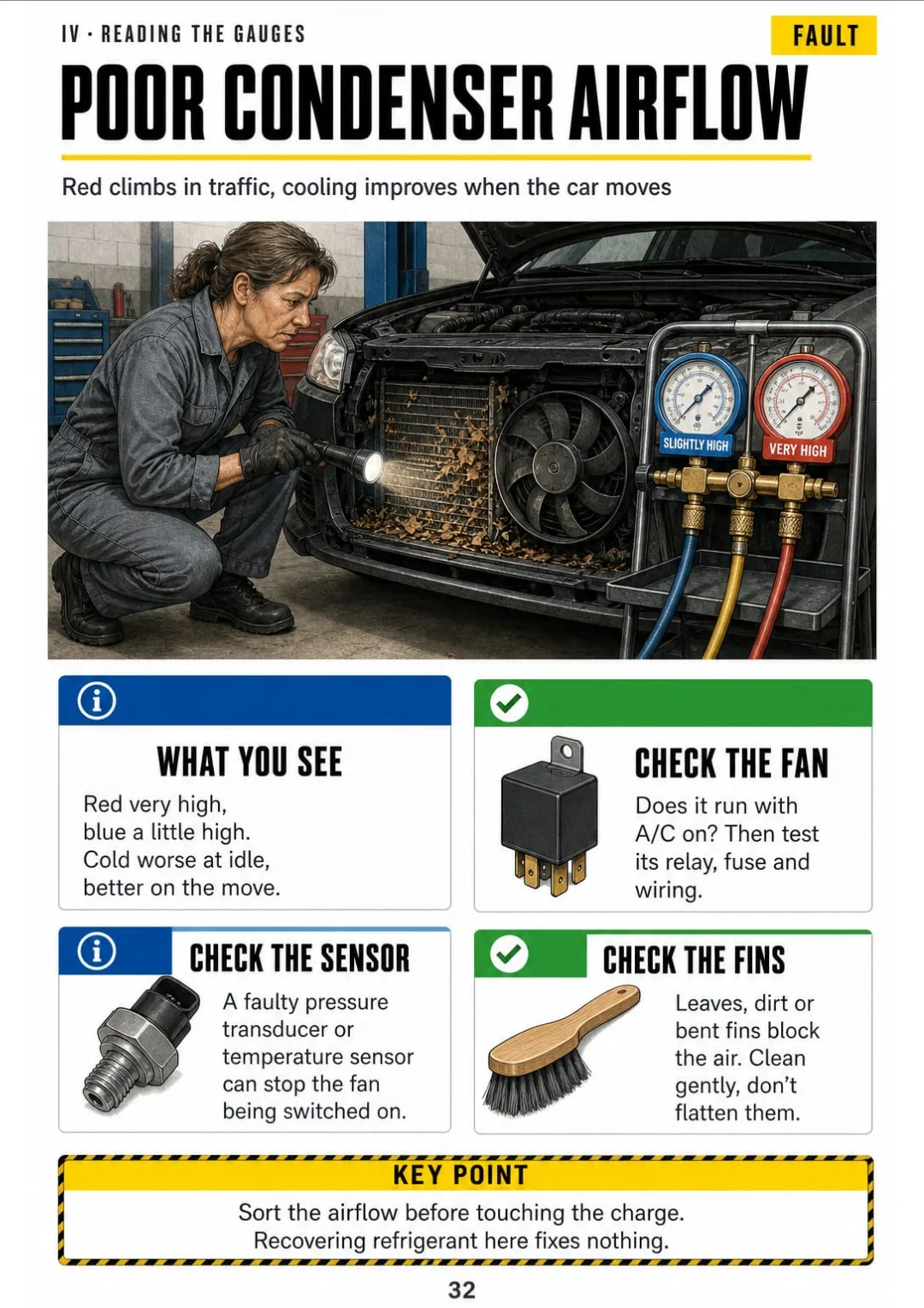
Read any gauge pair and know the fault: the test set up in the same order every time, then a healthy system, undercharge, overcharge, poor condenser airflow, restriction, weak compressor, a stuck expansion valve, moisture and air, each drawn as the needles sit.
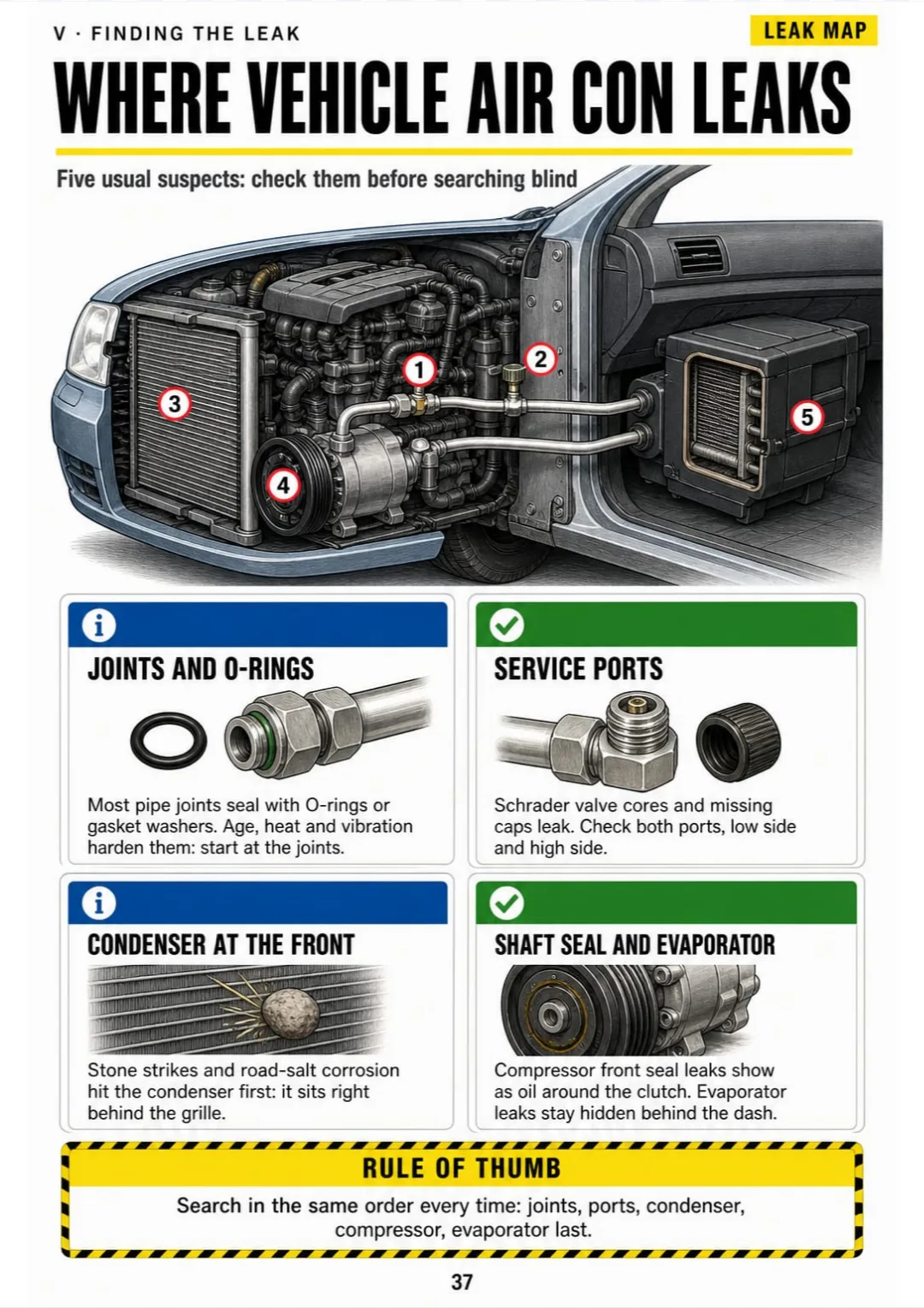
Where vehicle air con leaks, visual checks and oil traces, the electronic detector, UV dye and lamp, oxygen-free nitrogen and the nitrogen-hydrogen tracer gas.
The 7 checks, the couplers, recovery, measuring the old oil, vacuum and the hold test, oil and dye, charging by weight, the performance check and clearing the hoses.
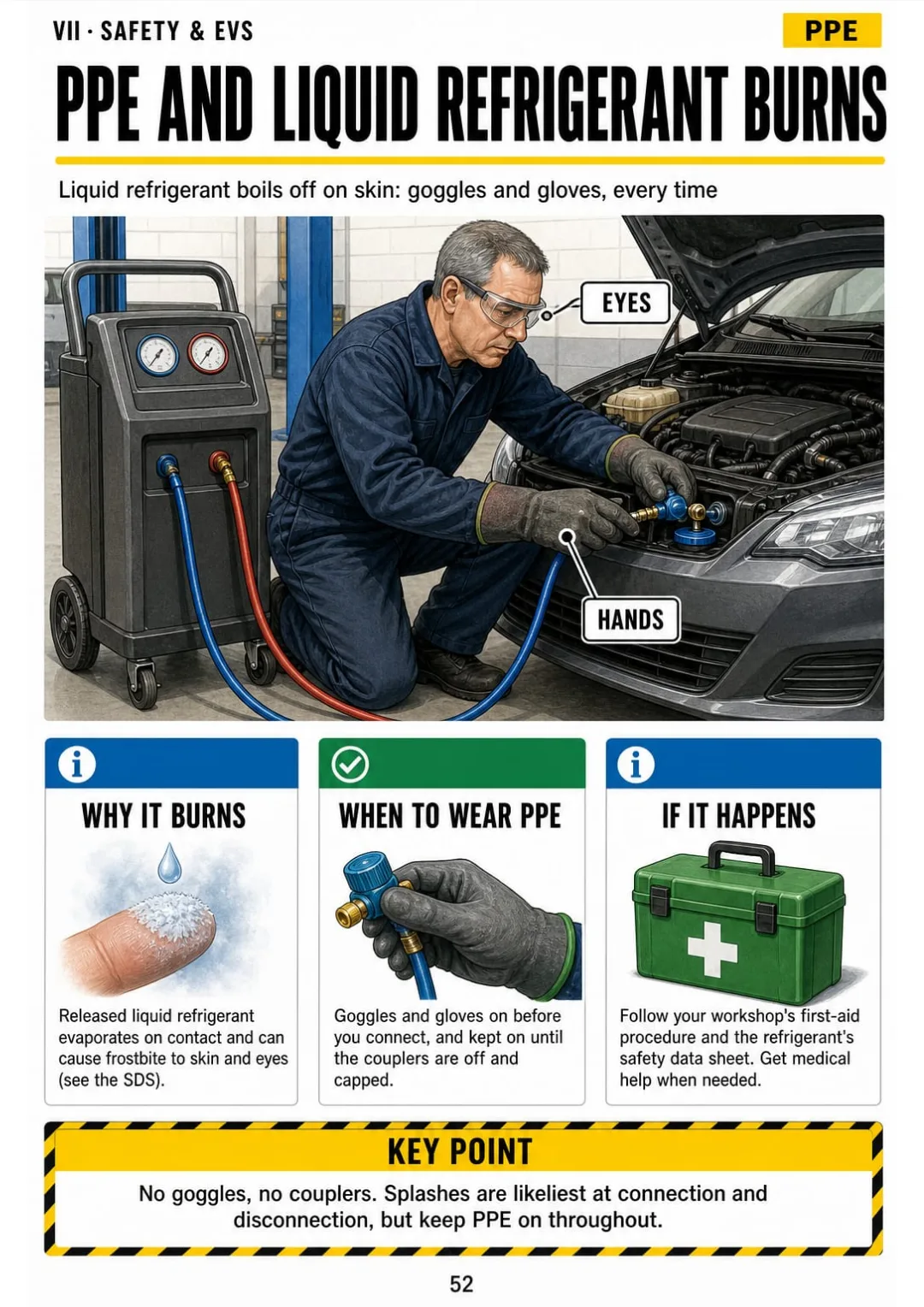
PPE and liquid refrigerant burns, ventilation and pits, R1234yf flammability and decomposition, electric compressors and high voltage, EV heat pumps and cylinder limits.
Which rules apply in GB and Northern Ireland, who needs the qualification and what it covers, venting, hazardous waste, records and labels, and the MAC rules.
The circuit from memory, every gauge fault on one page, the service sequence in one line, the most frequent mistakes and the key numbers and terms.
At the end of the book: A revision part with every gauge fault on one page, the service sequence in one line and the key numbers to have to hand.
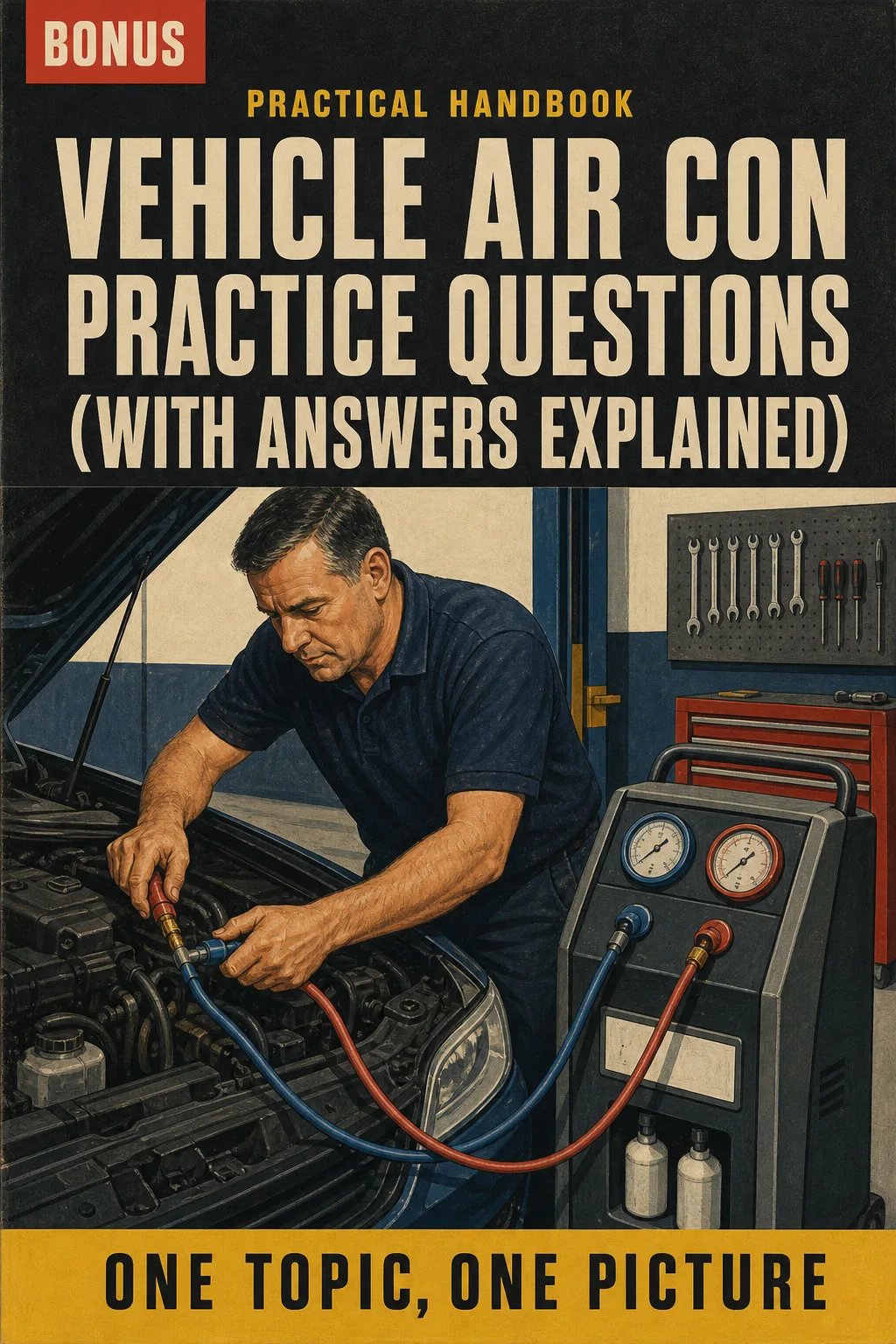
Assessment-style questions on the circuit, refrigerants, gauges and F-gas rules, each answer explained with the page to go back to, so you find your gaps before the day.

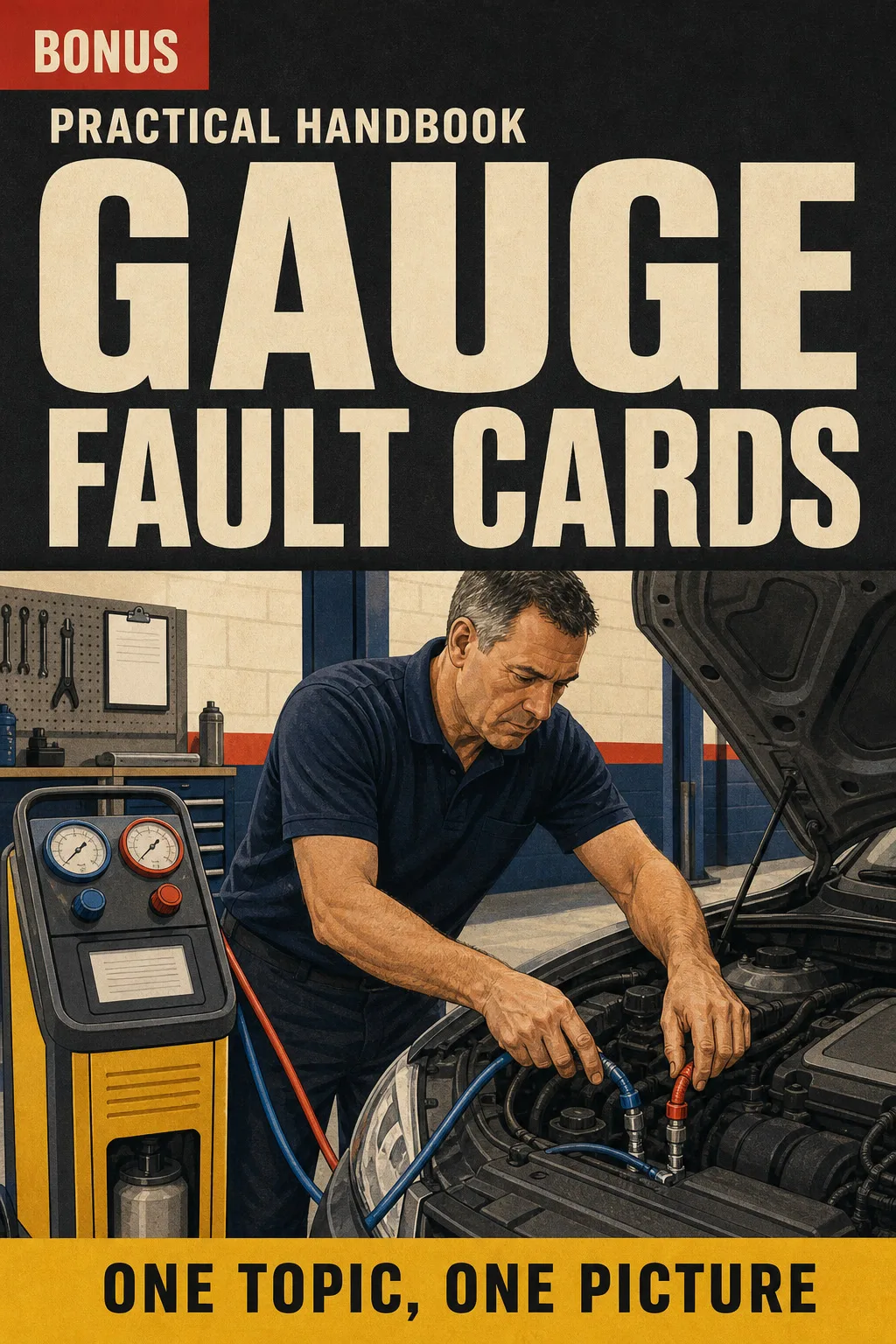
One card per fault: what the high and low side gauges show, what you feel at the vents and the likely cause, to revise in minutes or keep by the AC station.
📄 This is a digital PDF book sent to your email: nothing is printed or shipped.
PDF by email: We email you Vehicle Air Con F-Gas Illustrated as a PDF, together with the two free books. It's a single payment: no installments, no extra charges.
The theory stops being loose paragraphs: the circuit is one drawing that builds up, and every rule and procedure sits on its own page.
The revision part puts every gauge fault on one page and the service sequence in one line, and the practice questions show you where your gaps are.
Printed and kept by the AC station, it answers the R1234yf, POE oil and gauge questions without you reaching for your phone in front of the customer.
📄 This is a digital PDF book sent to your email: nothing is printed or shipped.
Try Vehicle Air Con F-Gas Illustrated for 30 days, bonus books included.
We refund everything if the file won't open, if the book isn't what you see here, if you were charged twice or if the email doesn't arrive. Just email us.
You pay once. No subscriptions.
Yes. It doesn't start from zero: it puts in order what you already do at the machine. R1234yf has its own pages (label, couplers, P-T curve, mild flammability), and so do hybrids and EVs (electric compressors, POE oil, high voltage, heat pumps), plus the GB F-gas rules.
From Regulations 517/2014 and 307/2008 as they apply in GB (assimilated law), the Fluorinated Greenhouse Gases Regulations 2015 (SI 2015/310) and the GOV.UK F-gas guidance for vehicle air con. Each reference is marked so you can check it against the current official version.
No. It's an independent illustrated study book, not material from any awarding body or government department. It's written for GB: it follows the topics of the vehicle air con refrigerant handling qualification under Regulation 307/2008 as it applies in GB, with GB units, rules and guidance, and a separate page for Northern Ireland.
No. It doesn't give you the qualification or a certificate: those come only from an accredited course and practical assessment. This book is for studying and revising alongside them. It doesn't replace accredited training or high-voltage training.
No. They're written for this book, in the style of the topics you'll be assessed on, and each answer points you back to the right page.
As a PDF by email, to the address you enter at checkout. The 2 free books come the same way.
No. It's a one-off payment.
Yes. It's a PDF ready to print, so you can keep the pages you need by the AC station.
You have 30 days. We refund everything if the file won't open, if the book isn't what you see on this page, if you were charged twice or if the email doesn't arrive: just email us.
No more rereading pages that don't stick.
Every gauge fault drawn as the needles sit, on its own page.
You walk into the assessment knowing where everything is.
Drawings make studying faster.
The book is right below.
One-time payment: US$ 27 · Guarantee: 30 days · PDF by email
YES, I WANT VEHICLE AIR CON F-GAS ILLUSTRATED FOR US$ 27📄 This is a digital PDF book sent to your email: nothing is printed or shipped.